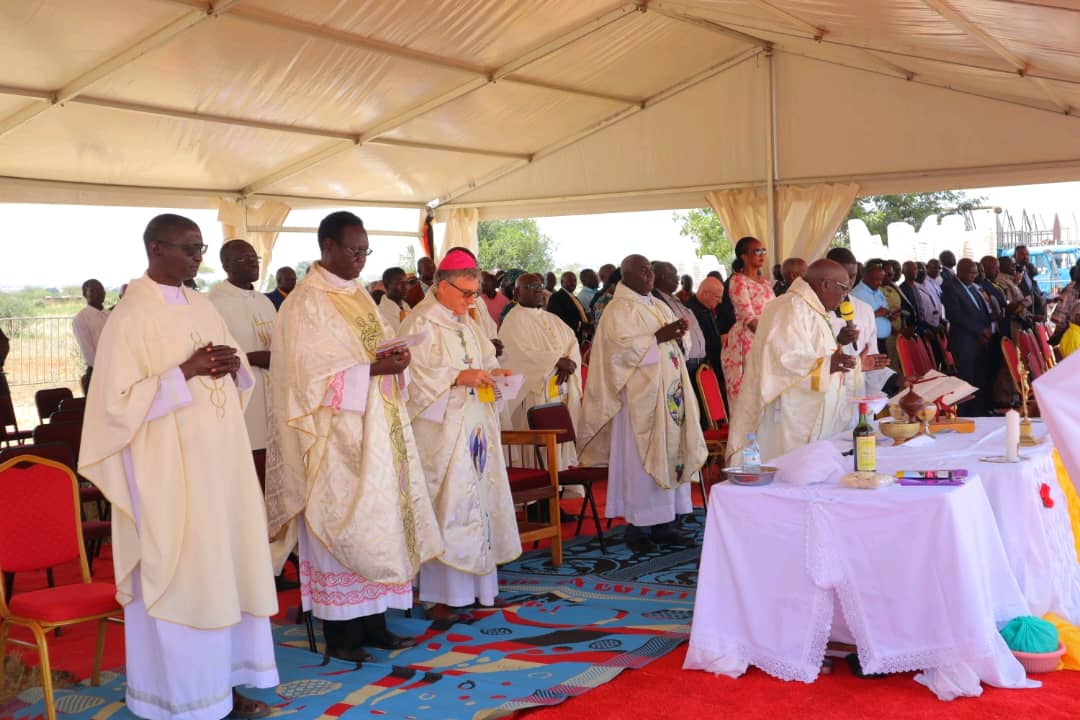
On November 23, 2025, a historic milestone for education, peace, and socio-economic progress was achieved in Karamoja with the official unveiling of the Karamoja Peace and Technology University (KAPATU) at a colorful ceremony in Losilang, Kotido. Though President Yoweri Museveni could not attend due to other commitments, his message, delivered by Prime Minister Emeritus Rt. Hon. Amama Mbabazi, underscored the government’s unwavering support for the transformative project. The event, which began with a mass led by Archbishop Emeritus Rt. Rev. John Baptist Odama, was attended by thousands of residents, cultural leaders, and development partners, marking a significant turning point for a region long ravaged by insecurity and underdevelopment.
Rt. Hon. Mbabazi, who is also the Chief International Fundraiser for KAPATU, highlighted the university’s alignment with Uganda’s national development goals. He emphasized that KAPATU represents more than just an academic institution—it is a catalyst for peace, skills development, and industrial growth in Karamoja and the broader Ateker region. His words reinforced the government’s commitment to uplifting Karamoja, a region with vast natural resources yet plagued by historical challenges such as poverty, climate disasters, and a lack of access to higher education.
The creation of KAPATU comes at a critical juncture for the Karamoja region, which has faced years of conflict and social instability. Despite its potential for animal husbandry and mining, these issues have stymied economic growth and left communities marginalized. However, local leaders like Mr. Charles Ichogor, the RDC of Kotido, are hopeful that KAPATU will mark the beginning of lasting peace and transformation. The university’s curriculum is designed to equip students with critical skills in peace education, science and technology, human rights, and community resilience, all while addressing the root causes of conflict, such as unemployment and social fragmentation.
The vision for KAPATU is one of inclusion and empowerment, according to Bishop Dominic Eibu of Kotido Catholic Diocese, who is also the proposed university president. He described the institution as a “hub of transformation,” dedicated to equipping the youth with the tools needed to build sustainable livelihoods and become agents of change in their communities. This sentiment was echoed by the Vice Chancellor-designate, Rev. Fr. Prof. Callisto Locheng, who commended the President’s commitment to the region and emphasized the critical support of key stakeholders such as the First Lady, Hon. Janet Museveni.
Local lawmakers also rallied behind the project. Hon. Loki Peter Abrahams, MP for Jie Constituency, expressed optimism that KAPATU would address both the historical and emerging challenges in Karamoja. He highlighted the importance of skill-building in the region and the university’s role in supporting government initiatives like the Parish Development Model. In a powerful moment of reconciliation, Hon. Abrahams also shared that President Museveni had recently expressed a willingness to pardon Karacunas—youth involved in cattle rustling—offering them a chance to rebuild their lives through education.
For many, KAPATU represents a long-awaited opportunity for the people of Karamoja to access quality education closer to home. Historically, students from the region have had to travel long distances to pursue higher education in central Uganda, often facing financial and social barriers. The arrival of KAPATU is seen as a game-changer for the region’s youth, who can now pursue advanced studies without leaving their communities. Hon. Lokii John Baptist, the NRM vice chairperson for Karamoja, described the university’s unveiling as historic, highlighting the fact that Karamoja had never before had a public or private university.
The university is not just about academic success but also about healing and unity. Leaders across Karamoja are optimistic that KAPATU will foster peace and collaboration among different communities. Kotido District Chairperson Lote Paul praised the university as a beacon of hope, signaling a new era for a region that has suffered from decades of violence and neglect. He also acknowledged the critical support of international stakeholders, including the Ethiopian government, who have helped bring the project to fruition.
KAPATU’s holistic approach to development goes beyond education. With a focus on peace-building, health, human rights, and technological innovation, the university aims to empower vulnerable communities, including women, former warriors, and marginalized households. Experts believe the integration of technical education with peace education will provide a comprehensive solution to the underlying causes of conflict in the region. By nurturing professionals capable of managing Karamoja’s natural resources responsibly, KAPATU has the potential to unlock new avenues for regional growth and sustainable development.
With over $200 million already secured for the KAPATU ERUPE Presidential Initiative—designed to bring water from Lake Bisina to Karamoja—the project is well on its way to achieving its ambitious goals. In the words of Rev. Dr. Mugisha Kagume of the National Council for Higher Education, KAPATU’s progress is already visible, with infrastructure development and human resource mobilization well underway. As Karamoja stands on the cusp of a new era, KAPATU is poised to become a global center of excellence, peace, and innovation, ushering in a brighter future for all.
About the Author