Uganda has secured a transformative €641.1 million (around Shs2.75 trillion) in external financing to fast-track three major infrastructure projects, marking a significant milestone in the country’s economic growth agenda. The agreements, signed with Standard Chartered Bank, are expected to bolster key sectors and improve living standards across the nation.
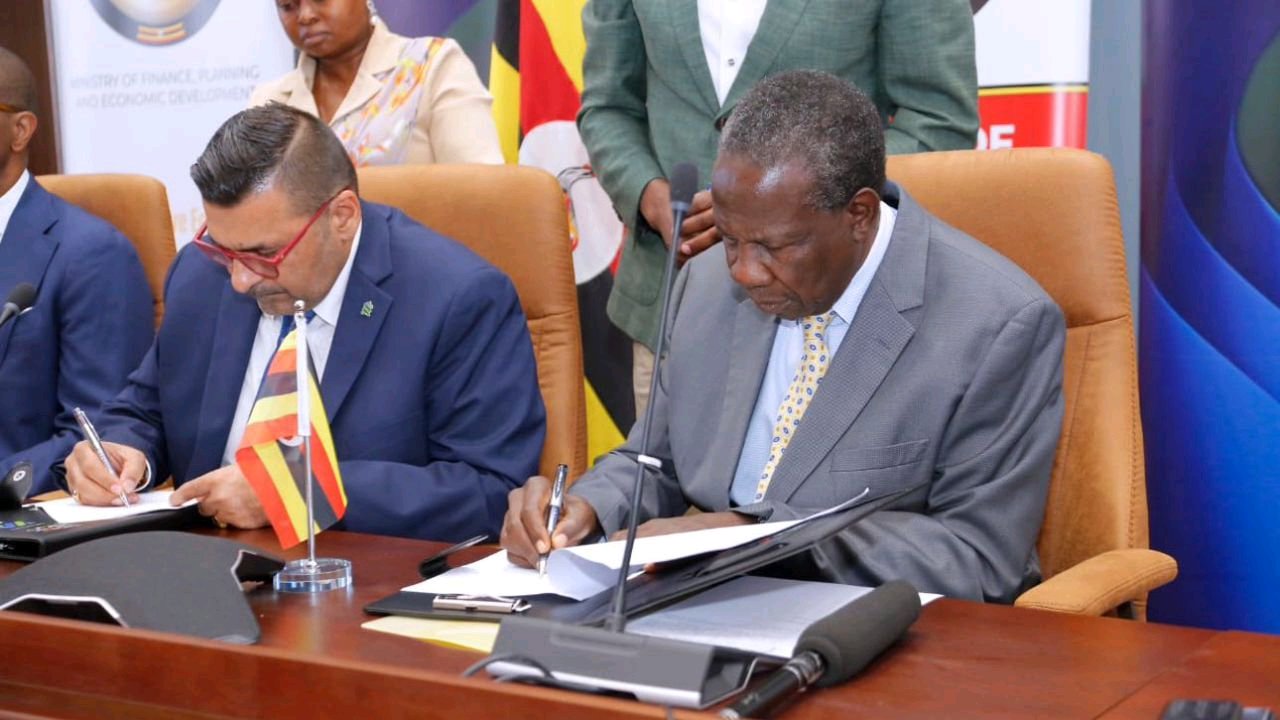
Finance Minister Matia Kasaija signed the agreements on behalf of the government, while Sanjay Rughani, CEO of Standard Chartered Uganda, represented the bank. The ceremony drew senior cabinet ministers, permanent secretaries, diplomats, bank executives, and project contractors, highlighting the high-level support for Uganda’s ambitious development plans.
The funding will be directed toward the power, water, and road sectors, supporting the government’s Ten-Fold Growth Strategy, which seeks to expand Uganda’s economy from USD 53 billion to USD 500 billion by 2040. Standard Chartered will arrange and co-finance the projects, leveraging international export credit agencies to secure favorable terms and long repayment tenors.
The largest facility, a €342.5 million (Shs1.4 trillion) loan, will fund the 400kV Karuma–Tororo double-circuit transmission line and the Ntinda substation. The project is designed to strengthen power evacuation from the Karuma Hydropower Plant, enhance supply to industrial centers like Tororo Industrial Park, and support regional electricity trade.
Minister Kasaija emphasized that the power project would minimize energy losses and promote industrial growth and employment. The financing is supported by Sweden’s Export Credit Agency (EKN) and the Swedish Export Credit Corporation (SEK), marking EKN’s first engagement in Uganda’s energy sector.
A second loan of €182.8 million (Shs754.5 billion) will fund Phase II of the Strategic Towns Water Supply and Sanitation Project, covering districts including Nakasongola, Kamuli, Mayuge, Bugweri, and Alebtong. The project aims to deliver clean water and improved sanitation to about 740,000 people by 2030, with backing from China’s export credit insurer, Sinosure.
The third financing, worth €115.8 million (Shs486 billion), will support construction of vital oil roads in the Albertine region, including the Karugutu–Ntoroko road, Rwebisengo link, and Ntoroko town roads. These developments are expected to advance oil sector operations, facilitate cross-border trade with the Democratic Republic of Congo, and enhance tourism around Lake Albert. The facility is insured by the Islamic Corporation for the Insurance of Investment and Export Credit (ICEIC).
Standard Chartered Africa CEO Dalu Ajene described the deal as a model for how governments and international financiers can structure complex, long-term projects with tangible economic and social impact. With these projects set in motion, Uganda is on course to strengthen its infrastructure, fuel economic growth, and improve quality of life for its citizens.
About the Author