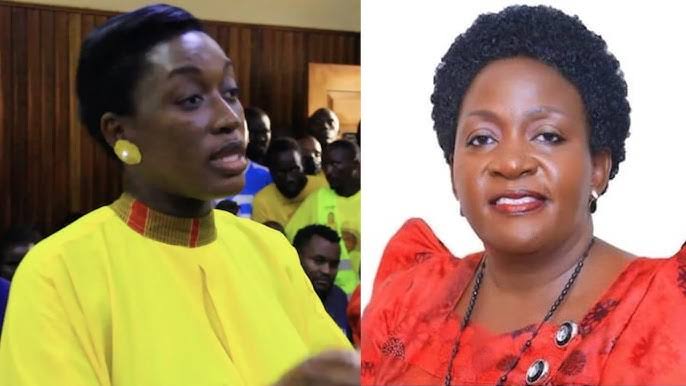
The political atmosphere in Masaka City has once again been thrown into the spotlight following a heated public exchange between National Resistance Movement (NRM) politician Justine Nameere Nsubuga and National Unity Platform (NUP) leader Hon. Rose Nalubowa. The disagreement comes in the wake of the controversial Masaka Woman Member of Parliament race, an election that has continued to generate debate among supporters of both political camps.
The latest confrontation started when Hon. Rose Nalubowa expressed disappointment over developments surrounding the election. In a statement shared online, Nalubowa said it was unfortunate that Masaka City had become associated with what she described as a “wall of shame,” arguing that the situation did not reflect the wishes and dignity of the people of Masaka.
Her remarks quickly attracted attention from political observers and supporters, many of whom interpreted them as a criticism of the election outcome and the processes that followed. Nalubowa’s comments reignited discussions about one of the most talked-about electoral contests in the region.
However, it was Justine Nameere’s response that dramatically escalated the situation. In a strongly worded statement, Nameere accused Nalubowa of political dishonesty and claimed that the NUP politician had privately admitted to being an NRM supporter.

According to Nameere, Nalubowa once approached her and requested to be introduced to President Yoweri Museveni. Nameere alleged that during that encounter, Nalubowa confessed that she had only joined NUP because she believed the opposition party offered her an easier path to electoral victory in Masaka.
The NRM politician further claimed that Nalubowa calculated that NUP’s popularity in Masaka would guarantee her an automatic win, regardless of her personal political convictions. These allegations have since sparked intense debate on social media, with supporters from both sides defending their respective leaders.
Nameere did not stop there. She argued that Nalubowa has never publicly denied the allegations because, in her view, the claims are true. She accused the opposition politician of continuing to “masquerade” before the public while hiding her alleged political beliefs.
In one of the most striking parts of her statement, Nameere claimed that the people of Masaka had already seen through Nalubowa’s political strategy. She suggested that voters had become aware of what she described as hypocrisy and political opportunism.
The exchange has brought renewed attention to the highly contested Masaka Woman MP race. The election attracted significant national interest because of the political importance of Masaka, a region often viewed as a stronghold for opposition politics.
Initially, Hon. Rose Nalubowa was announced as the winner of the race, a result that was celebrated by her supporters and many NUP members. The declaration appeared to cement another major victory for the opposition party in the area.

However, the situation changed dramatically when concerns were raised regarding the vote tallying process. Calls for a review of the results soon emerged, leading to further scrutiny of the election figures.
The controversy deepened when President Museveni publicly called for a closer examination of the electoral process. His intervention led to a recount of votes, a move that immediately generated mixed reactions across the political spectrum.
Supporters of the recount argued that every vote deserved to be accurately counted and that any irregularities needed to be addressed. On the other hand, critics questioned the circumstances surrounding the decision and expressed concerns about its implications.
Following the recount, the election results took an unexpected turn. Justine Nameere was eventually declared the winner, overturning the earlier announcement that had placed Nalubowa ahead.
The revised outcome triggered celebrations among NRM supporters while causing frustration and disappointment among many NUP followers. The developments further intensified political tensions within Masaka and beyond.
Since then, the election has remained a topic of discussion among residents, political analysts, and party supporters. Many continue to debate whether the recount reflected the true will of the voters or whether it raised new questions about electoral management.
The latest verbal confrontation between Nameere and Nalubowa has only added another layer to an already controversial political story. Their public disagreement highlights the deep divisions that often emerge during fiercely contested elections.

Political observers note that accusations of party loyalty and political opportunism are not uncommon in Uganda’s competitive political environment. However, such claims can significantly influence public perception, especially when made by high-profile political figures.
For now, Nalubowa has maintained her criticism of the events surrounding the election, while Nameere continues to defend both the recount process and her victory. The contrasting narratives have left supporters from both camps firmly entrenched in their positions.
As the debate continues, the people of Masaka remain at the center of the political storm. Many residents are more interested in seeing leaders focus on service delivery and development rather than prolonged political disputes.
Whether the latest allegations will have any lasting political impact remains to be seen. What is certain, however, is that the Masaka Woman MP race continues to be one of the most discussed and controversial political contests in recent memory, with both Justine Nameere and Rose Nalubowa remaining key figures in an unfolding political drama.
About the Author