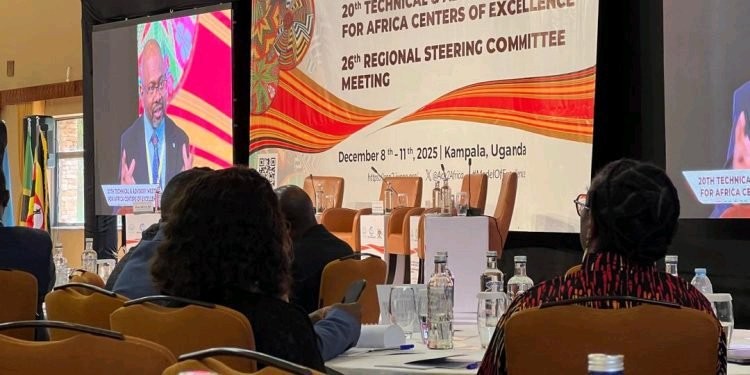
Kampala has become the focal point for scientific advancement this week, as over 10,000 researchers, PhD holders, and experts from across Africa gathered at Speke Resort Munyonyo for the 20th Technical and Advisory Meeting of the Africa Centers of Excellence (ACE). This prestigious event, one of the continent’s most influential scientific gatherings, offers a dynamic platform for sharing knowledge, fostering partnerships, and charting a unified course toward a knowledge-driven future for Africa.
The four-day conference, running from December 8 to 11, officially kicked off with a powerful address by Uganda’s First Deputy Prime Minister and Minister for East African Community Affairs, Rt. Hon. Rebecca Kadaga. In her speech, Kadaga highlighted the crucial role of regional collaboration in scientific research, urging delegates to pool their expertise to solve Africa’s most pressing challenges while ensuring that innovation translates into real-world benefits for communities.
This year’s summit has drawn a diverse range of participants, including engineers, medical scientists, university leaders, policymakers, and industry innovators. The discussions at the conference are centered around the ACE II program, launched in 2016 by the Inter-University Council for East Africa (IUCEA) in partnership with African governments and the World Bank. The initiative is dedicated to strengthening postgraduate education and applied research, equipping Africa with a skilled workforce capable of addressing critical socio-economic issues.
As outlined in ACE II documentation, the program focuses on key sectors essential to Africa’s development, including Agriculture, Health, Education, Industry, and Applied Statistics. These sectors are vital to the continent’s needs for innovative solutions in areas such as food security, healthcare improvement, industrial growth, data management, and informed policymaking.
Since its launch, ACE II has facilitated the establishment of 29 specialized regional centers hosted by 18 universities across eight African countries. Over 9,500 students, with more than a third of them women, have participated in Masters and PhD programs under the initiative. These graduates are becoming a critical force for research, innovation, and sustainable development across the continent.
One of the broader goals of ACE II is to create lasting regional hubs of scientific excellence capable of providing homegrown solutions to Africa’s challenges. By promoting collaboration between universities, governments, and industries, the program seeks to ensure that research outputs lead to tangible, life-improving applications across the continent.
The Munyonyo summit also places a strong emphasis on nurturing Africa’s human capital and strengthening cross-sector partnerships. The conference offers a valuable space for knowledge exchange, mentorship, and capacity-building, where institutions can learn from each other’s successes and obstacles. These interactions are designed to foster collaborations that could result in groundbreaking advancements in agriculture, healthcare, technology, and data analytics.
Uganda’s role as the host of the 20th ACE meeting underscores its growing stature as a hub for academic excellence, research, and innovation. By bringing together thousands of scientists, policymakers, and innovators, the country has reinforced its commitment to advancing science-driven development. The summit serves as a clear signal of Uganda’s dedication to building the continent’s knowledge economy and forging collaborations that will reshape Africa’s scientific future for generations to come.
About the Author