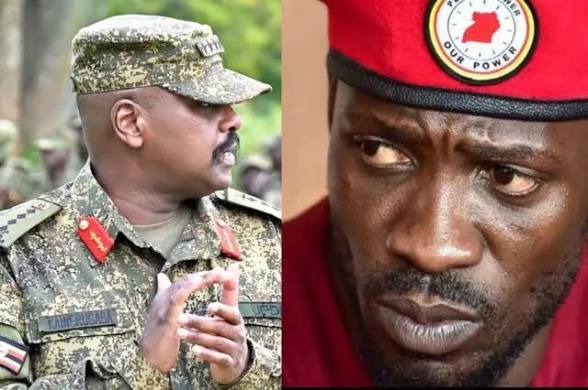
A fresh political storm has erupted in Uganda after a dispute surrounding the reported abduction of opposition lawyer and politician Erias Lukwago escalated into an extraordinary public confrontation between opposition leader Robert Kyagulanyi, popularly known as Bobi Wine, and Chief of Defence Forces Muhoozi Kainerugaba.
The controversy began after reports emerged that Lukwago had allegedly been taken away by armed operatives from his home in Wakaliga as he prepared to serve court summons connected to legal proceedings involving opposition veteran Dr. Kizza Besigye and Gen Muhoozi.
The development immediately attracted widespread public attention because Lukwago is not only a prominent opposition politician but also one of Uganda’s most respected lawyers and a leading figure in several high-profile legal battles involving government critics.
As news of the incident spread, Bobi Wine took to social media and launched a strong attack against Muhoozi, accusing him of abusing power and undermining legal processes through the use of military influence.
The National Unity Platform president claimed that Lukwago’s detention was politically motivated and argued that it represented a broader pattern of intimidation directed at opposition leaders, activists, and legal practitioners.
Bobi Wine further alleged that security operatives acting under Muhoozi’s authority had targeted Lukwago because of his role in legal cases involving Dr. Kizza Besigye, who remains one of the country’s most prominent opposition figures.

The opposition leader argued that the reported detention demonstrated the increasing use of security institutions in political disputes and warned that such actions threatened the rule of law and democratic accountability.
As public debate intensified, Bobi Wine escalated his criticism by directly attacking Muhoozi’s character and leadership style, accusing him of behaving in a manner unworthy of a senior military officer.
In one of the most widely shared remarks, Bobi Wine described Muhoozi as a “national drunkard,” a phrase that quickly went viral across social media platforms and became one of the most discussed political expressions of the day.
The opposition leader also accused Muhoozi of being a coward who relied on state power rather than engaging critics through open debate or lawful institutions, claims that immediately generated strong reactions from both supporters and opponents.
Bobi Wine went on to argue that Muhoozi’s actions were damaging the image of the Uganda People’s Defence Forces and undermining public confidence in national institutions that are expected to serve all citizens impartially.
His comments resonated strongly among opposition supporters, many of whom echoed concerns about the treatment of political opponents and the growing influence of security agencies in public affairs.
However, Muhoozi did not remain silent and quickly responded through social media, dismissing Bobi Wine’s accusations and launching a personal counterattack against the opposition leader.
In his response, Muhoozi accused Bobi Wine of drug abuse and mocked him with nicknames that he has previously used during political exchanges, further escalating the already heated confrontation

The exchange soon transformed what had initially been a dispute about Lukwago’s reported detention into one of the most personal and public political feuds seen in Uganda in recent months.
Political analysts observed that the confrontation reflected the increasingly hostile nature of political discourse in Uganda, where disagreements between major figures are often fought through social media before a nationwide audience.
Many observers noted that beyond the personal insults, the underlying issue remains the circumstances surrounding Lukwago’s reported detention and the broader concerns it has raised regarding human rights, legal independence, and political freedoms.
Supporters of the opposition argue that the incident demonstrates the urgent need for stronger protections for lawyers, activists, and political actors involved in sensitive legal and political cases.
Government supporters, meanwhile, contend that opposition leaders frequently use such incidents to advance political narratives and mobilize public sympathy against state institutions.
As the controversy continues to dominate headlines, attention remains focused on both the fate of Lukwago and the increasingly bitter rivalry between Bobi Wine and Muhoozi, two figures whose political influence continues to shape Uganda’s national conversation.
About the Author