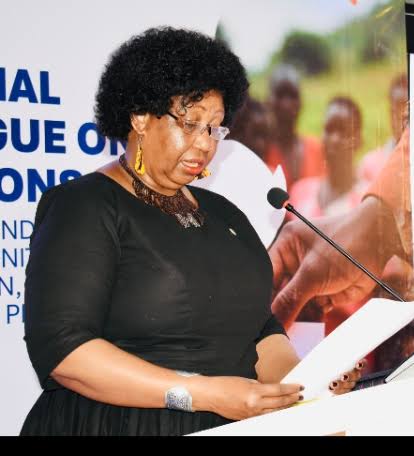
A major disagreement has emerged at the Uganda Human Rights Commission (UHRC) after three members of the Commission openly challenged their Chairperson, Mariam Wangadya. The dispute has created public interest after Wangadya responded to the accusations by revealing what she described as a difficult working environment and alleging that some of the opposition against her leadership is being influenced by political actors.In an interview with the media on Friday, July 3, 2026, Wangadya said she had received warnings about the challenges ahead even before she assumed office as UHRC Chairperson in 2021.
She explained that after appearing before Parliament for vetting, two Members of Parliament escorted her out, and one of them warned her that a commissioner she would work with would attempt to frustrate her leadership.She said the MP predicted that she would face daily attacks, intimidation, disrespect and attempts to destroy her reputation. Wangadya stated that although she hoped the warning would not come true, the situation later unfolded as she had been cautioned.The Chairperson revealed that her first encounter with the commissioner in question immediately showed her that she was facing a difficult working relationship.
She alleged that the commissioner claimed to have previously influenced the removal of former Energy Minister Irene Muloni after writing a report that was later submitted to the President.Wangadya said she had never experienced such hostility throughout her years of service. She alleged that the commissioner repeatedly reminded her about alleged files concerning her at security agencies, including the Internal Security Organisation (ISO) and Chieftaincy of Military Intelligence (CMI).She said she remained calm because she knew her record and had confidence in her conduct as a public servant. Wangadya emphasized that since joining government service in 1996, she has maintained her integrity and has never faced questions about her loyalty to the country.She further alleged that she was constantly reminded that she was not born in Western Uganda and was treated as an outsider. According to her, she was repeatedly told that she would not complete her six-year term as Chairperson of the Uganda Human Rights Commission.Wangadya accused some commissioners of promoting allegations that she was under investigation. She dismissed those claims as part of a wider campaign aimed at damaging her reputation and undermining her leadership at the Commission.The UHRC boss claimed that the campaign against her is being supported by MPs whom she had earlier reported to the President over alleged attempts to solicit bribes. She said the continued attacks against her involve individuals with strong political and financial influence.
She alleged that one of the MPs she testified against in court has played a leading role in supporting the campaign against her. She also accused a particular media outlet of repeatedly publishing reports targeting her and claimed that some of the coverage has been influenced by ethnic bias.Wangadya said that although President Yoweri Kaguta Museveni later forgave the MPs involved in the matter, they have never accepted her role in exposing the allegations. She maintained that she acted within the law and carried out her responsibilities as a government official.The Chairperson appealed to the Director of Public Prosecutions to reopen a case in which she was the complainant. She said she had already testified and was prepared to appear before court again to undergo cross-examination so that the truth could be established.She added that if the case cannot be reopened, she would like to present an audio recording related to the controversy so that the public can understand the events that led to the current accusations and conflict.Wangadya also raised concerns about the standards used in appointing members of the Uganda Human Rights Commission. She emphasized that the Commission has a critical constitutional mandate of protecting and promoting the rights of Ugandans and therefore requires leaders with strong ethical values.
She referred to Article 51 of the Constitution, which states that UHRC leaders should be persons of high moral standards and proven integrity. Wangadya said she wished these requirements had been given greater consideration during the appointment process.The Chairperson defended her long public service record, noting that she has served Uganda for 30 years, including eight years as Deputy Inspector General of Government and a period as Acting IGG. She said she rejected bribes, refused to compromise investigations and resisted pressure from powerful individuals.She concluded by dismissing allegations that she has misused funds at the Uganda Human Rights Commission. Wangadya argued that UHRC operates with limited resources and urged journalists to verify allegations through the Inspectorate of Government. She called for professional, balanced and fact-based reporting as the controversy continues.
About the Author