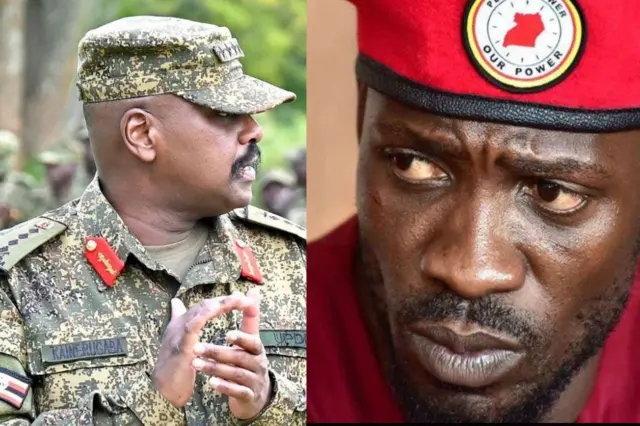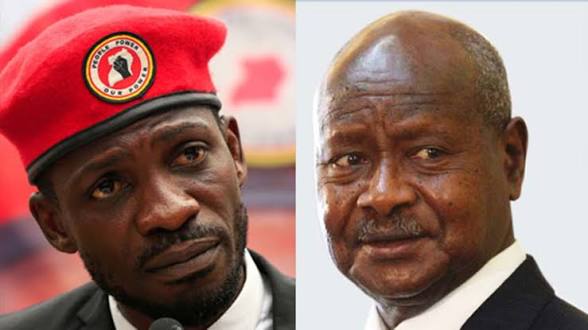
Exiled National Unity Platform (NUP) president Robert Kyagulanyi, popularly known as Bobi Wine, has explained why he frequently reposts statements made by Chief of Defence Forces Gen. Muhoozi Kainerugaba on social media, saying his intention is not to promote the army chief but to expose what he describes as wrongdoing by the Ugandan government.
Bobi Wine made the remarks during an interview with journalist Isaac Kaiyz Kawalya, where he addressed his continued decision to amplify Gen. Muhoozi’s posts on X. According to the opposition leader, reposting the statements gives them a much wider audience, particularly among people outside Uganda who may otherwise never see them.
The former presidential candidate said he believes his large social media following gives him an opportunity to draw international attention to statements made by people within the government. He argued that when he personally makes allegations against President Yoweri Museveni or his administration, some people dismiss his claims, but when government officials make controversial statements themselves, he believes those statements can speak for themselves.
“I do not like what Museveni does, but it is important that I show it to the world. I show the world the evil that he does, because when I am the one speaking it seems that I am telling lies,” Bobi Wine said during the interview.
He explained that the same strategy applies to Gen. Muhoozi, saying the army chief does not have the same level of international social media reach that he has. Bobi Wine said he therefore deliberately gives Muhoozi’s posts additional visibility by reposting them to his own followers.
“The same applies to his son. When he posts on social media, he does not have a lot of followers like me. That is why when he posts, I come out and amplify it to the world,” Bobi Wine said.

According to Bobi Wine, the strategy sometimes creates an unexpected reaction because Gen. Muhoozi may interpret the increased attention as an attempt to promote him. The opposition leader, however, said he views the situation differently and believes that exposing the posts allows people to judge the statements and actions for themselves.
“Then he thinks I am promoting him. I have been a star for all these years. I know what it means to have attention which is what he craves,” Bobi Wine added, explaining why he does not consider the increased visibility of Muhoozi’s posts to be a problem.
Bobi Wine said his broader objective is to ensure that Ugandans and the international community have access to information about statements coming from senior government officials. He argued that citizens and international actors should be able to see what powerful figures say publicly rather than relying only on statements made by opposition politicians.
“It helps the citizens and those who seek our freedom to show the world that this is the evil that this person is doing,” he said, reiterating his argument that social media can be used as a tool for exposing controversial government conduct.
The NUP leader further said that he wants the international community to pay attention to Gen. Muhoozi’s public statements. He explained that, in his view, making such statements widely known can encourage greater scrutiny of Uganda’s political and human rights situation.
“I want the world to see him. I want to make him popular so people can see him,” Bobi Wine said, describing the strategy behind his repeated amplification of the army chief’s social media posts.
Bobi Wine compared his approach to the international campaign against apartheid in South Africa, arguing that exposing alleged abuses to the outside world can play an important role in generating international attention. He referenced Nelson Mandela and other anti-apartheid activists as an example of leaders who sought international awareness of events taking place in their country.
“I have mentioned before that if the crimes of the Apartheid regime were not exposed by Mandela and his people to the world, he would have continued to be seen as a terrorist,” Bobi Wine said, drawing a comparison between the historical anti-apartheid struggle and his efforts to publicise what he considers abuses in Uganda.
During the interview, Bobi Wine also spoke about the relationship between international pressure and Uganda’s foreign assistance, particularly support from the United States. He claimed that Washington had previously been sending Uganda about $1 billion annually and alleged that the amount had since been reduced because of information exposed by opposition activists.
“The US has been sending $1 billion a year, they have reduced this amount because we exposed the president,” Bobi Wine claimed, linking what he described as reduced American support to international scrutiny of Museveni’s government.
The claim about the scale and reasons for changes in US assistance is Bobi Wine’s assertion and would require independent verification to establish the exact amount of assistance involved and whether any reductions were directly caused by his campaign or the exposure of alleged government abuses.
Bobi Wine has repeatedly used his social media platforms to comment on statements by Gen. Muhoozi, particularly posts touching on opposition politicians, human rights activists and foreign diplomats. His reposts have often been accompanied by criticism of the government and appeals for international attention to Uganda’s political situation.

The NUP leader has remained outside Uganda since March 2026 after leaving the country following the January 15 presidential election. Bobi Wine has said that he feared for his safety after security operations around his home and threats that he attributed to government and security officials, although the political circumstances surrounding his departure remain highly contested.
Since relocating abroad, Bobi Wine has continued his international political campaign, including meetings with American lawmakers and other officials in Washington. He has used these engagements to raise issues relating to Uganda’s governance, democracy, human rights and the treatment of opposition figures.
His latest comments therefore highlight how Bobi Wine is using social media not only to communicate with his supporters but also as part of a wider international advocacy strategy. By amplifying statements from senior government figures, he says he hopes to allow audiences outside Uganda to see the statements directly and form their own conclusions about the country’s political situation.
Bobi Wine’s remarks are likely to continue generating debate because his strategy places Gen. Muhoozi’s social media activity at the centre of an international political communication battle. While Bobi Wine insists that he is exposing rather than promoting the army chief, the repeated reposting of Muhoozi’s statements inevitably gives those posts greater visibility, making social media an increasingly important platform in Uganda’s political contest.
About the Author