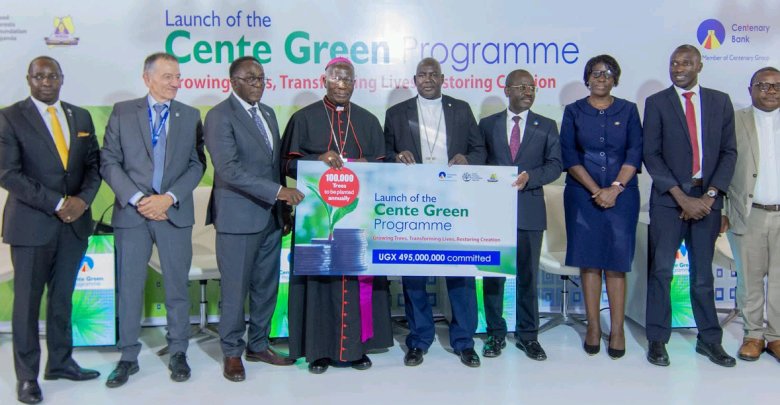
Centenary Bank has launched a five-year environmental initiative aimed at supporting the growing of 500,000 indigenous timber and fruit trees across Uganda by 2030, in a major push to restore degraded landscapes and strengthen community resilience to climate change.The programme, dubbed Cente Green Days, was launched in Kampala on August 28, 2026, under the theme “Growing Trees, Transforming Lives, Restoring Creation.”
The initiative is expected to combine environmental conservation with economic opportunities for communities that will participate in growing and maintaining the trees.Speaking at the launch, Centenary Bank Managing Director Godfrey Byekwaso said the programme reflects the bank’s Environmental, Social and Governance commitments and its wider responsibility to promote sustainable development. He said protecting the environment is closely linked to the prosperity of businesses, households and communities.Centenary Bank plans to support the planting of about 100,000 indigenous timber and fruit trees annually for the next five years. This year alone, the programme targets approximately 300 acres of degraded land across 12 districts, with the total restoration target expected to reach about 1,500 acres by 2030.
The bank is implementing Cente Green Days in partnership with the Uganda Episcopal Conference and Good Forests Foundation, with 12 dioceses already participating. They include Arua, Nebbi, Kiyinda-Mityana, Jinja, Masaka, Mbarara, Kabale, Kasese, Kotido, Moroto, Fort Portal and Tororo.Byekwaso said the partnership with the Catholic Church was informed by its strong presence and influence within communities, as well as its long-standing role in promoting environmental stewardship. He noted that the Church also has access to land that can be restored and can mobilise communities to take environmental conservation as a shared responsibility.
Good Forests Foundation will provide technical support throughout the programme, including guidance on assessing restoration sites, selecting suitable tree species, planting, maintenance and monitoring. The technical expertise is expected to improve tree survival rates and ensure that restored areas deliver lasting environmental benefits.According to Byekwaso, the programme will also have direct benefits for participating communities by improving soil protection, supporting food security and creating opportunities for households to diversify their incomes. Indigenous fruit and timber trees are also expected to help communities cope with erosion, floods, drought and other effects of climate change.
The initiative builds on Centenary Bank’s previous environmental efforts, having supported the growing of more than 250,000 trees across Uganda since 2023. The bank also began measuring its carbon emissions in 2025, recording more than 6,000 tonnes of carbon dioxide equivalent, and says it is now taking deliberate measures to reduce its environmental footprint while supporting carbon sequestration through tree growing.
About the Author