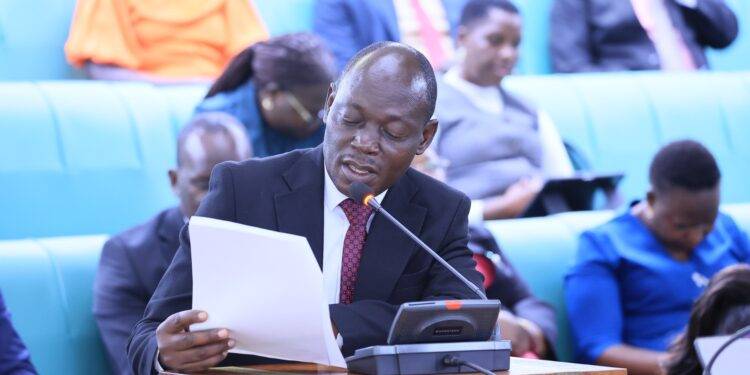
Former Katikkiro of Buganda, Daniel Mulika, has stirred controversy after making remarks that have generated widespread discussion among political observers and social media users. Speaking during a recent public engagement, Mulika criticized supporters of the ruling National Resistance Movement (NRM), arguing that their unwavering loyalty to the party raises questions about their independent thinking.
According to Mulika, whenever he encounters a supporter of the NRM, he immediately recalls a statement that has often been attributed to President Yoweri Museveni regarding the performance of Members of Parliament. Mulika claimed that this statement reflects the mindset that has shaped the behavior of many supporters within the ruling party.
The former Katikkiro said he believes many NRM supporters follow the party leadership without critically analyzing decisions or policies. In his view, political support should be based on careful reasoning and evaluation rather than automatic loyalty to a political organization.
Mulika referenced a past comment allegedly made by President Museveni suggesting that even a sleeping NRM Member of Parliament would be more useful than an attentive opposition legislator. He argued that such a statement sends a message that loyalty to the ruling party is valued above active participation in parliamentary debate.

According to Mulika’s interpretation, the logic behind the statement is that an NRM legislator, even if inactive during discussions, would eventually vote in favor of government positions once called upon to do so. This, he said, demonstrates a political culture that rewards obedience rather than critical engagement.
The former Buganda premier questioned how democracy can fully thrive when elected leaders are expected to support decisions simply because they originate from their party leadership. He argued that Parliament functions best when representatives actively contribute to debates and challenge ideas where necessary.
Mulika went on to suggest that the strength of any democratic institution depends on the ability of its members to think independently. He maintained that political leaders should be encouraged to evaluate policies on their merits rather than relying solely on party directives.
His comments quickly attracted reactions from various political circles. Some opposition supporters applauded his remarks, arguing that they highlighted concerns about party discipline and independent decision-making within the ruling establishment.
However, supporters of the NRM strongly disagreed with Mulika’s assessment. Many argued that party cohesion is a normal feature of political systems around the world and should not be mistaken for a lack of intelligence or independent thought.
Several commentators pointed out that political parties often expect their elected representatives to support agreed policy positions. They argued that party unity is essential for implementing government programs and maintaining political stability.

Others viewed Mulika’s comments as unnecessarily provocative. They noted that millions of Ugandans support different political parties for a variety of reasons, including ideology, historical experience, development priorities, and personal conviction.
The debate has once again highlighted the deep political divisions that continue to characterize Uganda’s political landscape. Discussions about party loyalty, parliamentary independence, and democratic accountability remain central themes in national political discourse.
Observers say that remarks such as Mulika’s often resonate because they touch on broader questions about the role of elected leaders. Citizens frequently expect Members of Parliament to represent their constituents while also balancing party interests.
Political analysts note that tensions between party discipline and individual independence are not unique to Uganda. Similar debates occur in democracies around the world whenever legislators are expected to vote along party lines.
For many Ugandans, the controversy is less about the specific statement and more about the larger issue of whether elected officials should prioritize party loyalty or independent judgment when making decisions that affect citizens.
Mulika’s comments have also revived discussions about the quality of parliamentary debate. Critics of strong party discipline argue that robust debate leads to better laws and policies, while supporters contend that party cohesion is necessary for effective governance.

Social media platforms were soon flooded with reactions from both supporters and critics of the former Katikkiro. Some praised him for speaking candidly, while others accused him of unfairly insulting ordinary citizens who support the ruling party.
NRM supporters defended their political choices, arguing that supporting a particular party does not determine a person’s intelligence or ability to think independently. Many stressed that political affiliation should not be used as a measure of intellectual capability.
Meanwhile, opposition supporters used the remarks as an opportunity to renew calls for greater independence among legislators. They argued that elected representatives should be willing to challenge policies they believe are not in the public interest, regardless of party affiliation.
As the debate continues, Mulika’s comments are likely to remain a topic of discussion among politicians, analysts, and the general public. Whether viewed as a critique of political culture or an overly harsh assessment of NRM supporters, the remarks have once again sparked conversation about the relationship between party loyalty, democratic participation, and independent thinking in Uganda’s political system.
About the Author