The question of how much African presidents earn has continued to attract public attention, especially in East Africa, where leaders preside over countries with very different economies, populations and political systems. In 2026, available estimates suggest that the official monthly salaries of East African heads of state vary significantly, with some presidents earning several times more than their counterparts. However, government salary is only one part of the financial picture, because personal wealth can come from investments, agriculture, property, businesses and assets accumulated before or during a political career.
The East African region has eight member states under the East African Community, namely Uganda, Kenya, Tanzania, Rwanda, Burundi, South Sudan, the Democratic Republic of Congo and Somalia. Ethiopia, although not an EAC member, is geographically and politically an important East African country and is therefore sometimes included in regional comparisons. For this reason, comparisons of presidential and national leadership salaries often include Ethiopian Prime Minister Abiy Ahmed alongside presidents from the EAC countries.
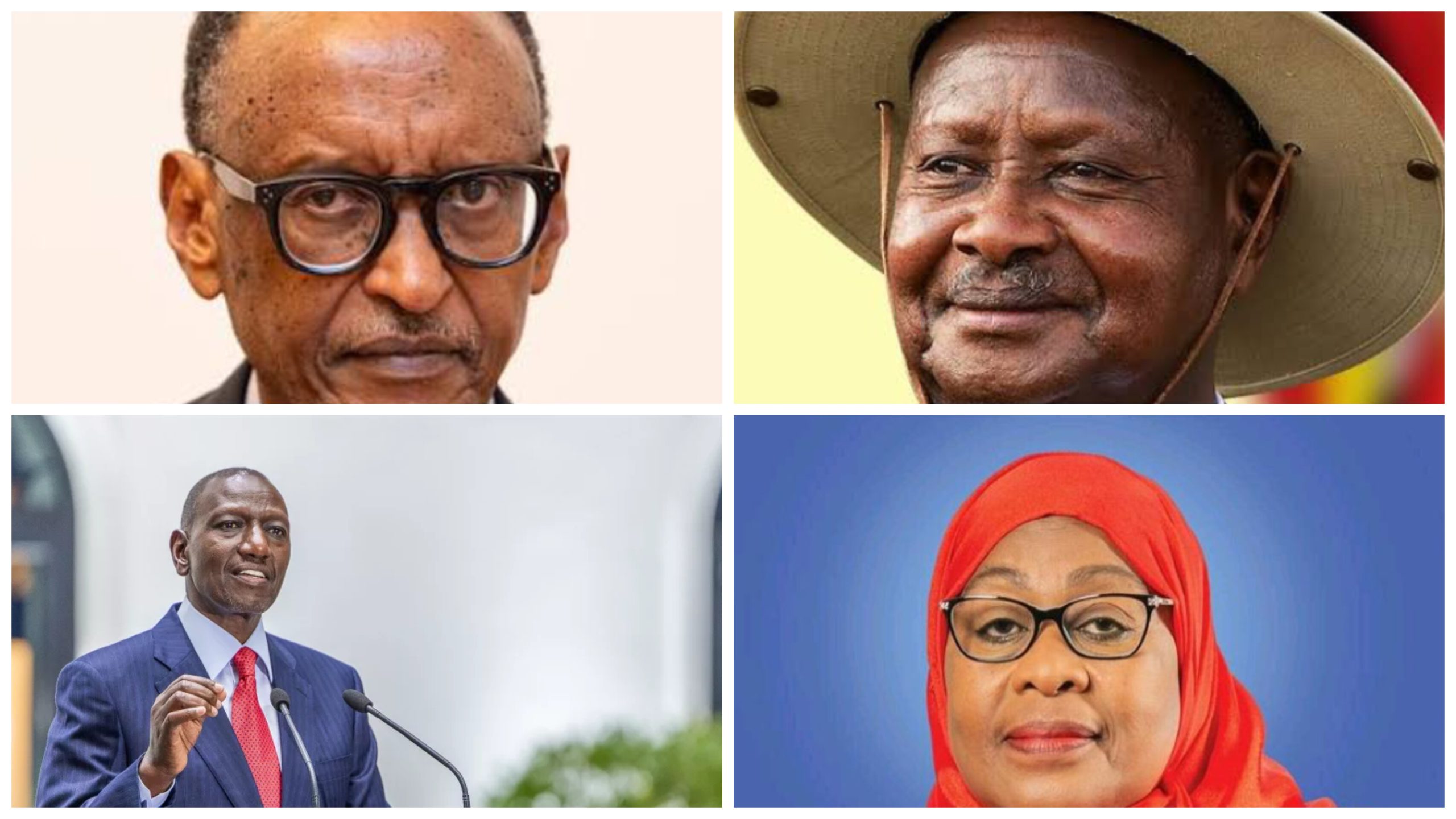
Among the leaders listed in available estimates, Kenyan President William Ruto is placed at the top in terms of official monthly remuneration, with his salary estimated at approximately US$14,000 per month. South Sudan’s President Salva Kiir Mayardit follows with an estimated monthly salary of about US$10,000, while Rwanda’s President Paul Kagame is often placed at around US$7,000. Ethiopia’s Prime Minister Abiy Ahmed is estimated at approximately US$6,500 per month, although he is a prime minister rather than a president.
Tanzania’s President Samia Suluhu Hassan and Somalia’s President Hassan Sheikh Mohamud are both estimated to earn approximately US$4,000 per month under figures cited in regional comparisons. Burundi’s President Évariste Ndayishimiye is estimated at roughly US$2,500 per month, while Uganda’s President Yoweri Museveni is placed near the bottom of the ranking at an estimated US$950 monthly. These figures should, however, be treated cautiously because presidential remuneration can include allowances, official benefits and other facilities that may not be captured by a basic salary figure.

William Ruto’s position at the top of the salary ranking does not automatically make him the wealthiest East African leader. His estimated personal net worth is sometimes placed at around US$450 million, although such figures are not independently audited and should therefore be regarded as estimates rather than confirmed financial declarations. Public reports have associated his wealth with agricultural enterprises, poultry farming, real estate, hospitality and various investments accumulated over many years.
Rwanda’s Paul Kagame is another leader whose estimated personal wealth is considerably higher than his official government salary. Some publicly circulated estimates place his net worth at approximately US$500 million, although there is no universally accepted independently audited figure confirming this amount. His financial profile has frequently been discussed in connection with investments, commercial interests and assets associated with his long political career, making comparisons between his official salary and estimated wealth particularly interesting.
Uganda’s Yoweri Museveni presents another striking contrast between official salary and estimated personal wealth. Available estimates sometimes place his official monthly salary at less than US$1,000, making it one of the lowest figures in the comparison. At the same time, various sources have circulated estimates placing his personal wealth at approximately US$200 million, with agriculture, livestock, ranching, family interests and other private investments frequently mentioned. These wealth estimates have not been independently verified through a comprehensive public audit.
South Sudan’s Salva Kiir occupies an interesting position because his estimated official salary is among the highest in the regional comparison, while reliable information about his personal net worth is far more difficult to establish. Although various reports have made claims about the assets and wealth of senior South Sudanese officials, there is no dependable, independently verified figure that can confidently be presented as Kiir’s personal fortune.
Ethiopian Prime Minister Abiy Ahmed is similarly difficult to rank by personal wealth. While some websites and unofficial sources publish net-worth figures for him, there is no credible independently verified estimate that can establish the exact value of his personal assets. His official remuneration is sometimes estimated at around US$6,500 per month, but that figure should also be understood as an estimate rather than a definitive statement of his complete compensation package.
Tanzania’s President Samia Suluhu Hassan is also not associated with a widely verified public estimate of personal net worth. Her official monthly salary is commonly estimated at around US$4,000 in regional comparisons, but presidential compensation can involve additional official benefits and allowances. Without a complete and independently audited declaration of personal assets, it would be difficult to establish her precise financial position compared with other leaders in the region.
Somalia’s President Hassan Sheikh Mohamud is likewise estimated to receive approximately US$4,000 per month, according to figures used in some regional salary comparisons. However, there is no reliable independently verified figure establishing his personal net worth. This illustrates why salary rankings are generally easier to compile than wealth rankings, since salaries are linked to public office while personal assets can be spread across different forms of property, investments and private interests.
Burundi’s President Évariste Ndayishimiye is estimated to earn approximately US$2,500 per month, placing him among the lower-paid leaders in the comparison. Publicly verifiable information about his personal wealth is limited, making it difficult to provide a reliable net-worth figure. As with several other leaders, the absence of a verified estimate does not mean that a leader has no significant assets; it simply means that reliable information is not publicly available.
Democratic Republic of Congo President Félix Tshisekedi is sometimes included in wider East African financial comparisons because of the DRC’s membership in the East African Community. Some unofficial estimates place his personal wealth between US$6 million and US$10 million, but these figures have not been independently audited and vary considerably between sources. Claims about his wealth have been linked to family business interests, inherited assets and personal investments, although caution is necessary when presenting such estimates as facts.
One important point when looking at these rankings is that presidential salary should never be confused with personal net worth. A salary represents the official income attached to a public position, while net worth represents the value of assets owned after accounting for liabilities. A person could therefore receive a relatively modest salary while possessing substantial assets accumulated through investments, businesses, agriculture, inheritance or other legitimate sources of wealth.
The difference becomes even more important when comparing presidents who have spent decades in politics. Long political careers can overlap with periods in which individuals build businesses, acquire land or make investments. However, the existence of wealth does not by itself establish how that wealth was obtained. Reliable conclusions about the source of a leader’s wealth require documented financial records, asset declarations, audited accounts and other verifiable evidence.
The figures also demonstrate why ranking presidents simply according to their salaries can produce a misleading picture. Ruto may rank highest in official monthly pay in the comparison, yet other leaders are estimated by some sources to possess larger personal fortunes. Conversely, a president with a low official salary cannot automatically be assumed to be personally wealthy simply because unofficial websites publish a large net-worth figure.

Another issue is the difference between official salary and the complete package received by a head of state. Presidents normally have access to official residences, security, transportation, medical arrangements, staff and other facilities provided by the state. Some of these benefits may have substantial monetary value but are not necessarily counted as part of the president’s monthly salary. Consequently, comparing only cash salaries does not provide a complete picture of the financial benefits attached to holding the presidency.
For Uganda, the contrast between Museveni’s reported official salary and the much higher unofficial estimates of his wealth has repeatedly generated public discussion. Museveni has governed Uganda for decades, and his family has been associated with agricultural and other interests. Nevertheless, estimates of his personal net worth should not be treated as established fact unless supported by independently verifiable financial documentation.
The same caution applies to estimates concerning Ruto, Kagame, Tshisekedi and other regional leaders. Net-worth websites frequently publish figures without explaining the methodology used to calculate them, and different sources can produce dramatically different numbers for the same individual. This means readers should distinguish between an estimated figure circulating online and a wealth figure supported by an audited declaration or authoritative financial record.
Ultimately, the 2026 comparison provides an interesting look at the difference between official presidential remuneration and estimated personal wealth across East Africa. William Ruto is placed first among the listed leaders in terms of estimated monthly government salary, followed by Salva Kiir and other regional leaders, while Museveni is placed near the bottom on official salary. Yet the wealth estimates tell a completely different story, with some leaders reportedly possessing fortunes far larger than what their government salaries alone could explain.
The biggest lesson from the comparison is that salary and wealth measure two completely different things. Government salary tells us what a public official is formally paid for holding office, while net worth attempts to measure the value of everything that person owns after liabilities are considered. Because several of the wealth figures cited in regional comparisons are unverified estimates, they should be treated as indicative rather than definitive. Any serious ranking of East African leaders’ finances should therefore rely on official remuneration records, credible asset declarations and independently verifiable financial information rather than online estimates alone.
About the Author