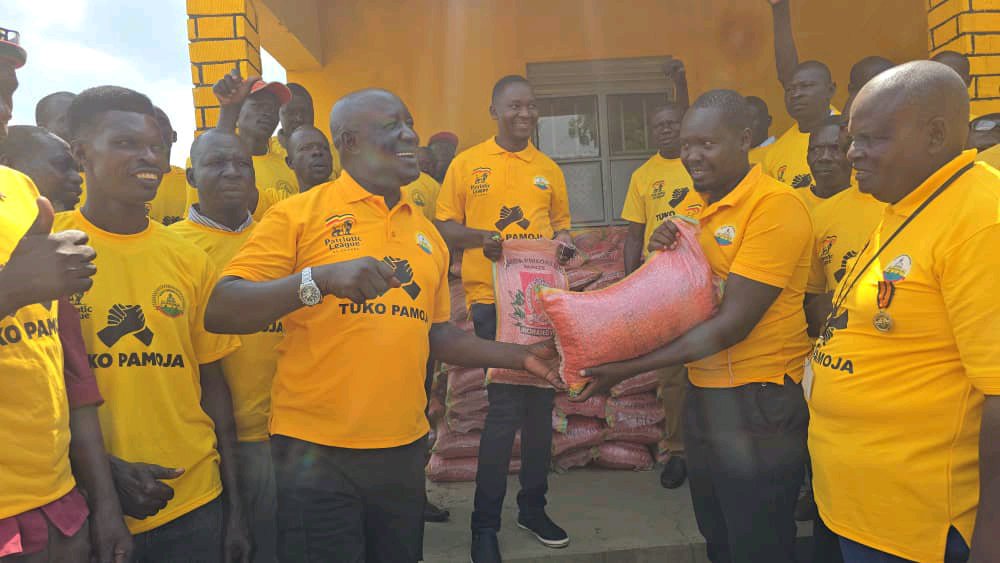
Former Arrow Boys commanders in the Teso sub-region have declared their support for Gen. Muhoozi Kainerugaba as they begin mobilising around what they describe as preparations for Uganda’s political transition in 2031.The former commanders, who were part of the local force that supported government troops during the Lord’s Resistance Army insurgency in Teso, have returned to the political spotlight more than two decades after the group was formed.
Their mobilisation comes as political activities surrounding Gen. Muhoozi’s 2031 ambitions continue to take shape. Gen. Muhoozi publicly announced his intention to run for President in 2031 earlier this month, according to reporting by Daily Monitor.The former Arrow Boys say their current mobilisation is not aimed at demanding an immediate change of government but at preparing communities for what they believe could be a future political transition.The Arrow Boys were formed in Teso in 2003 when the LRA launched attacks in the sub-region. Local residents organised themselves to support the Uganda People’s Defence Force in resisting the insurgency.The force became an important part of the local response to the LRA, with former commanders later becoming prominent figures in Teso politics and public life.Musa Ecweru, who rose to prominence through his role during the Teso insurgency, was among those associated with the Arrow Boys during the conflict.
Contemporary reporting has described his role in coordinating the local resistance alongside other leaders.After the conflict ended, some former Arrow Boys were absorbed into formal security institutions while others returned to their communities and resumed civilian life.The former commanders now say they want to bring members of the old network together around several issues, including community development, security, welfare and political mobilisation.
According to the commanders, about 12 of their leaders first travelled to Kampala to communicate their position at the headquarters of the Patriotic League of Uganda before returning to Teso.They subsequently mobilised other former commanders, with 119 commanders reportedly gathering in Teso as part of the campaign to communicate their message across the region.Ecweru has said the former commanders believe Uganda should prepare for any future political transition well in advance in order to avoid disruption and protect peace and development.The commanders have also cited Gen. Muhoozi’s involvement in Teso during the LRA insurgency as one of the reasons behind their support.They recall that Muhoozi, who was then serving as a major, was involved in operations in the region during the period when the LRA was exerting pressure on communities.Robert Adiyama Ekaju, a former Arrow commander who served as head of counter-intelligence from 2003 to 2007, said former fighters remember Muhoozi as someone who worked alongside them during the difficult period.
The former commanders therefore say their current support is partly influenced by their past experience of working with Muhoozi during the insurgency.Their mobilisation is being conducted alongside activities associated with the Patriotic League of Uganda, which they describe as promoting peace, development and other national interests.The former Arrow Boys insist that supporting Muhoozi does not mean they are seeking to remove the current government. Instead, they say they are preparing for what they describe as a possible transition in the future.They want Gen. Muhoozi to be available for what they call a possible “call to duty” in 2031, while President Yoweri Museveni continues to govern under the existing political arrangement.
The development has placed the former Arrow commanders among the groups publicly mobilising around the question of Uganda’s leadership beyond 2031.However, political mobilisation is not the only issue being raised by the former fighters.The commanders are also seeking government assistance for former Arrow Boys who remained in their communities after the insurgency and were not integrated into the police or UPDF.Ecweru has said thousands of former auxiliaries remain in communities across Teso and have not received the same institutional support as those who entered the formal security services.The former commanders say they have proposed a one-off financial appreciation for some of the former fighters, with a list of potential beneficiaries reportedly prepared and submitted to army authorities.In the meantime, the commanders are also encouraging their members to participate in agriculture and other income-generating activities.
As part of the initiative, each commander was reportedly given 10 kilogrammes of improved maize seed and three kilogrammes of improved soybean seed.Plans have also been mentioned to provide additional planting materials, including coffee and cocoa seedlings, as part of efforts to improve household livelihoods.The former Arrow commanders are also seeking a role in community security, arguing that their knowledge of local communities could be useful in addressing emerging security concerns.They have raised concerns about young men locally referred to as “wokwok”, whom they associate with activities such as roadblocks, assaults and other forms of lawlessness in parts of Teso.The commanders are calling for stronger cooperation between their leaders, police and other security agencies to address crime and drug abuse.Their return to public mobilisation marks a new phase for a group that was originally created during one of the most difficult periods in Teso’s recent history.From an armed community auxiliary force during the LRA insurgency, the former Arrow Boys have increasingly sought roles in community development, security, agriculture and political mobilisation.
Their endorsement of Gen. Muhoozi now places them within the wider political discussion surrounding Uganda’s 2031 leadership transition.For the former commanders, their message is that the networks created during the war can now be used for what they describe as promoting peace, development and preparing communities for Uganda’s next political chapter.
About the Author