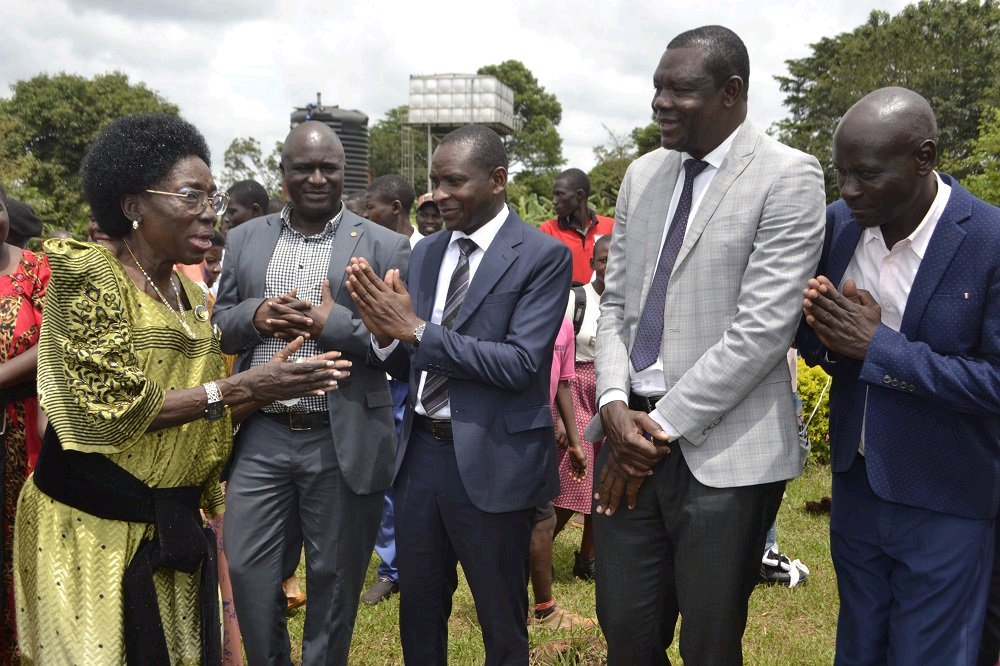
First Deputy Prime Minister Rebecca Kadaga has urged the Ugandan government to adopt the “Real Fathers Parenting and Family Model” as a national strategy to fight domestic violence and build stronger families. She made the call during the belated Women’s Day celebrations at Bulopa Secondary School in Kamuli District, where community leaders welcomed her warmly.
Kadaga commended HOLD Uganda for leading efforts to address domestic and gender-based violence in the Busoga sub-region.
She noted that harmful cultural norms around gender roles continue to weaken parenting, disrupt family cohesion, and limit social development.
“The Real Fathers Project reflects our vision of a society where women, children, and men are all treated with dignity,” Kadaga said. She highlighted its measurable impact in reducing intimate partner violence and violence against children, advocating for its adoption nationwide.
The program, implemented by HOLD Uganda with backing from the Impact and Innovations Development Centre and the Ministry of Gender, Labour and Social Development, with funding from the LEGO Foundation, focuses on mentoring young fathers aged 16 to 25. It equips them with practical skills in parenting, relationship communication, gender equality, health, and nutrition.
Kadaga emphasized that boys and men must also be empowered if the gains made for girls are to last. She warned that an empowered girl marrying an unempowered boy risks having her achievements overshadowed, making initiatives like Real Fathers essential for promoting balance in families.
She further criticized the tendency of men to distance themselves from parental responsibilities. Fathers’ absence in school meetings and household decisions, she said, fuels irresponsible parenting and contributes to societal issues such as child marriage, school dropouts, and defilement.
Charles Mudhumba, Executive Director of HOLD Uganda, revealed that more than 19,000 young fathers in Busoga have undergone training. Mentorship sessions focus on responsible fatherhood, family leadership, and positive communication, resulting in men becoming more engaged, supportive, and non-violent toward their families.
Kadaga concluded by calling on government agencies and development partners to champion initiatives that cultivate responsible masculinity and strengthen fatherhood. Experts believe that scaling the Real Fathers model nationwide could significantly reduce domestic violence and stabilize families across Uganda.
About the Author