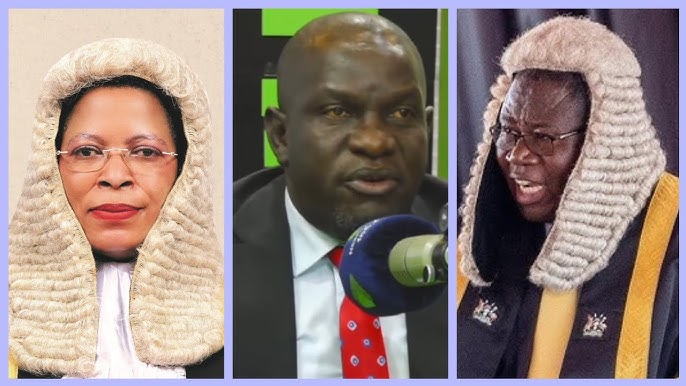
In what is being hailed as one of the most decisive anti-corruption measures within Parliament in recent years, Speaker Jacob Oboth-Oboth has dramatically reduced the budget allocated to the Office of the Speaker, cutting it from more than Shs24 billion to just Shs3.9 billion.
The move, announced during celebrations marking the reappointment of Prime Minister Robinah Nabbanja, will see over Shs20 billion redirected to parliamentary committees to strengthen their oversight role and operational independence.
Oboth-Oboth said the decision was aimed at restoring Parliament to its original mandate of holding government institutions accountable rather than operating as a center for discretionary spending.
According to the Speaker, parliamentary committees have for years struggled with inadequate funding, limiting their ability to effectively conduct investigations, carry out field visits and scrutinize public expenditure.
He revealed that his office would no longer retain the large donations budget that has traditionally been controlled by the Speaker, insisting that those resources are better utilized in supporting committee work.
“I’ve gotten back my office. It will have Shs3.9 billion from the Shs24 billion. When you come to me, I will tell you the money has gone to the committees,” Oboth-Oboth declared.

He emphasized that Parliament must focus on strengthening its institutional functions instead of competing with other government offices in providing financial assistance to individuals and groups.
In a pointed remark, Oboth-Oboth stated that the President remains the government’s chief benefactor and that those seeking donations should direct their requests elsewhere.
“The Chief Donor of Government remains the President of Uganda. If you need help, go to State House. We are resetting Parliament back to the factory default—what Parliament was intended to be,” he said.
The Speaker announced that every parliamentary committee will now be required to develop detailed and costed work plans that will guide the allocation and utilization of funds.
Under the new arrangement, committees will receive direct financial support to undertake oversight activities without depending on ministries, departments or agencies that fall under their supervision.
Oboth-Oboth argued that chronic underfunding has created opportunities for corruption by forcing legislators to seek facilitation from institutions they are expected to investigate and hold accountable.
“We want to insulate Parliament from being vulnerable to ministries, departments and agencies,” he said while explaining the rationale behind the budget restructuring.
He warned that accepting even small amounts of money from government agencies can compromise the independence of legislators and weaken the credibility of parliamentary oversight.
“There is nothing more demeaning than asking for small money from those you are supposed to supervise. These agencies come before you having stolen money, then they give you one or two million shillings and you become compromised,” he remarked.
The Speaker said making adequate resources available to committees would remove temptation and allow Members of Parliament to carry out their constitutional responsibilities without external influence.
He stressed that both committee chairpersons and ordinary members would benefit from the new funding model, ensuring that oversight activities are conducted professionally and effectively.

Beyond committee funding, Oboth-Oboth also raised concerns about the prolonged construction of Parliament’s new chamber, questioning why the project has remained unfinished despite receiving budget allocations for more than a decade.
He disclosed that substantial sums of money remain available for the project, including Shs22 billion allocated in the current financial year, yet progress on the construction has remained disappointingly slow.
“How can you build that chamber from 2014 up to now? It is not that the money is not there. This year alone there is Shs22 billion. There is money lying in Parliament’s account in the Bank of Uganda. People want kickbacks,” he said.
Presenting himself as a leader determined to challenge entrenched interests, Oboth-Oboth said he was not intimidated by those who may oppose the reforms, noting that his journey from humble beginnings to the Speaker’s office had prepared him for difficult battles.
His announcement marks a significant shift from spending practices that emerged in recent years, particularly the growth of large donation budgets under parliamentary offices.
The decision is expected to spark fresh debate on accountability, transparency and the proper use of public funds, while earning praise from legislators who have long demanded greater support for oversight activities in the fight against corruption.
About the Author