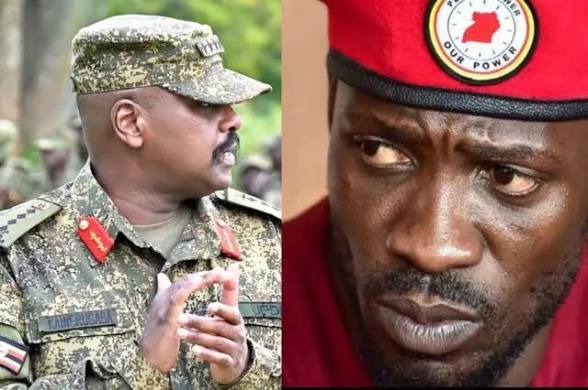
Chief of Defence Forces Muhoozi Kainerugaba has reportedly made new controversial remarks suggesting that opposition leader Robert Kyagulanyi would face arrest upon returning to Uganda, a statement that has quickly sparked debate across the political spectrum.
The comments, which circulated widely on social media, have generated strong reactions from both supporters and critics, further intensifying already strained relations between government and opposition figures.
According to the widely shared claims, Muhoozi suggested that Bobi Wine had allegedly sought assurances that he would not be arrested upon returning from time spent in the United States.
The remarks also included an assertion that such assurances would not be granted, with Muhoozi reportedly stating that Bobi Wine would “definitely be arrested” upon return.
These statements have not been independently verified but have nonetheless dominated political conversations and online discussions across Uganda.
Opposition supporters immediately condemned the reported remarks, arguing that they reflect growing political intolerance and the use of security institutions in partisan disputes.

They further claimed that threatening arrest based on political activity undermines constitutional protections and democratic freedoms.
Bobi Wine, who leads the National Unity Platform, has in the past faced multiple arrests and legal challenges linked to his political activities and public mobilization.
His supporters argue that repeated confrontations with security agencies highlight broader concerns about political space and freedom of expression in Uganda.
Government supporters, however, maintain that law enforcement actions are based on legal grounds and national security considerations rather than political affiliation.
They argue that no individual is above the law and that any returnee facing allegations must be held accountable through established legal processes.
The controversy has reignited debate about the role of security leaders in public political communication, especially when statements are made on social media platforms.
Analysts note that such remarks, whether official or informal, often carry significant weight due to the senior position held by the individuals involved.

The situation has also drawn attention to the long-standing rivalry between Muhoozi and Bobi Wine, which has increasingly played out in public online exchanges.
Political observers say the exchange reflects deeper divisions within Uganda’s political landscape, particularly regarding opposition activity and state response.
The incident also highlights the growing trend of political discourse being conducted through direct social media statements rather than institutional communication channels.
As reactions continue to emerge, many Ugandans are calling for calm and urging leaders to avoid inflammatory rhetoric that could heighten political tensions.
Others are demanding clarity from official institutions regarding whether any legal proceedings or planned actions exist against opposition leaders returning from abroad.
For now, the remarks remain a subject of intense public debate, reflecting the ongoing friction between Uganda’s political leadership and opposition movements.
About the Author