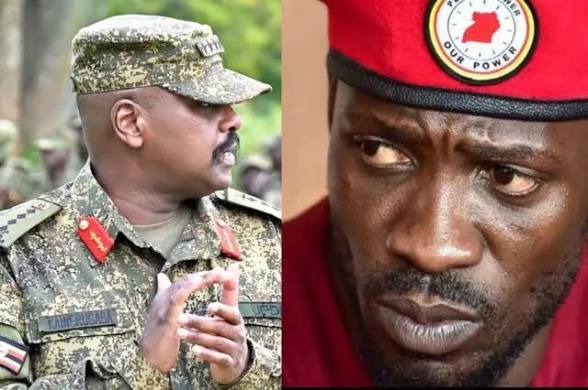
Uganda’s political temperature rose sharply after comments circulating online and attributed to Chief of Defence Forces Gen. Muhoozi Kainerugaba suggested a dramatic realignment of the country’s parliamentary politics involving opposition lawmakers.
The remarks, which have not been independently verified by official government channels, quickly spread across social media platforms and triggered immediate political debate and public reaction.
In the widely shared statement, Muhoozi is alleged to have proposed that all opposition Members of Parliament, including those from the National Unity Platform (NUP), join the Patriotic League of Uganda (PLU).
The claim further suggests that such a political shift would amount to what he described in striking terms as “capturing Parliament.”
The alleged remarks also included unusual religious and historical references, with mentions of “Jesus Christ” and “the Holy Blood of the Bachwezi,” adding to the intensity of online discussion.
The combination of political and spiritual language immediately set off debate about whether the statement was literal, symbolic, or misinterpreted in circulation.

Supporters of Gen. Muhoozi argue that such messaging is often taken out of context online and may reflect political expression rather than an actual policy position.
Others, however, say the wording—if accurate—raises serious questions about respect for multiparty democracy and parliamentary independence.
Opposition supporters were quick to reject the idea of “capturing Parliament,” insisting that legislative authority must be determined strictly through elections.
They argued that any attempt to consolidate political power outside the ballot box would undermine constitutional democracy.
Civil society commentators also weighed in, urging restraint in political communication and warning against language that could heighten political tension.
Legal analysts noted that political speech by public officials carries significant weight and can easily influence public interpretation, especially when it involves state institutions.
They emphasized that Uganda’s Constitution provides for multiparty democracy and requires leadership transitions and parliamentary composition to be decided through electoral processes.
The National Unity Platform, led by Robert Kyagulanyi Ssentamu (Bobi Wine), remains one of the most prominent opposition forces in Parliament, making its inclusion in such claims particularly sensitive.
Political observers say the remarks—whether accurate or misinterpreted—highlight growing competition between established opposition parties and emerging political movements.

They also point to the increasing role of social media in amplifying political statements, often without verification or official context.
Some analysts believe the controversy reflects broader uncertainty about future political alignments ahead of upcoming election cycles.
Others caution that repeated circulation of unverified claims risks deepening mistrust between political actors and the public.
As of publication, no official statement has been issued by government or military spokespersons to confirm or clarify the alleged remarks.
Gen. Muhoozi Kainerugaba has also not publicly responded to the specific claims circulating online.
The controversy continues to dominate political conversations across Uganda, underscoring the sensitivity of discussions involving Parliament, opposition politics, and national leadership narratives.
About the Author