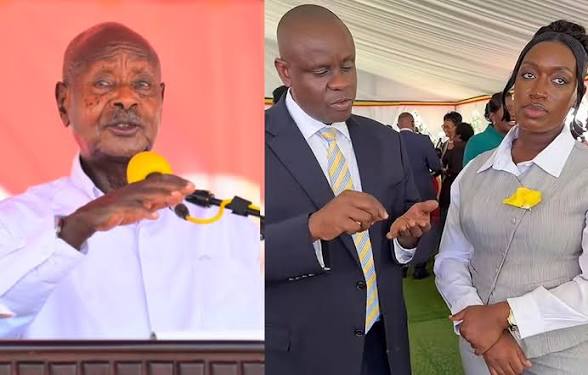
President Yoweri Museveni has praised Minister Balaam Barugahara and Justine Nameere for their efforts in fighting corruption and exposing challenges affecting government service delivery across the country.
Museveni said he was pleased that some leaders had taken up the responsibility of confronting corruption, describing Barugahara and Nameere as people making efforts to address problems affecting citizens.
“I am glad some people are trying to do some little fighting; that is Barugahara and Nameere,” Museveni said while addressing members of the National Resistance Movement (NRM) Parliamentary Caucus.
The President made the remarks during a meeting held at Speke Resort Munyonyo, where he discussed issues affecting the government and the country.
Museveni identified corruption as one of the major issues frustrating Ugandans and weakening confidence in government programmes.
He argued that corrupt individuals often manipulate information and create resentment among citizens by making people blame the government for failures caused by individuals misusing public resources.

According to Museveni, corruption in government programmes such as the Parish Development Model (PDM) has contributed to anger among communities because some leaders allegedly divert funds meant to benefit citizens.
“So this corruption, where you have local leaders taking PDM money, that is how you get local resentment,” Museveni said.
The President specifically praised Barugahara and Nameere for their nationwide campaign aimed at exposing corruption and poor service delivery in different parts of Uganda.
The two have been moving across districts, visiting communities and highlighting complaints from citizens about alleged misuse of government resources.
Museveni said such efforts are important because they help identify problems affecting government programmes and allow authorities to take action.
While speaking about Nameere’s political experiences in Masaka, Museveni claimed that she faced opposition from groups that attempted to weaken her influence during elections.
He compared the actions of corrupt networks to HIV, saying they weaken the body’s defence system by interfering with its ability to fight problems.
“This Nameere, they wanted to kill her in Masaka during the elections. There is a way they gang up, misinform people; they are like AIDS. AIDS kills by blocking the body’s soldiers. So these corrupt people; they start by taking over the information channels,” Museveni said.
Museveni claimed that after the elections, Nameere and her supporters approached him and expressed frustration over challenges they faced within local political structures.
He said the complaints helped him understand some of the difficulties affecting the NRM structures in Masaka.
The President linked corruption to poor implementation of government initiatives, saying citizens lose trust when officials demand money or misuse resources meant for them.
Barugahara and Nameere’s “Expose the Corrupt” campaign has attracted significant public attention because of its approach of making surprise visits to government offices and confronting officials accused of poor performance.

During their tours, the two leaders have listened to complaints from residents about alleged bribery, absenteeism, delayed services and misuse of government programmes.
Some residents have accused officials of demanding money before providing access to government services, claims that have sparked public debate.
The campaign has also focused on issues affecting health centres, local governments and other public institutions.
Museveni said fighting corruption requires exposing individuals who misuse their positions and ensuring that government programmes reach the intended beneficiaries.
He encouraged leaders to remain committed to serving citizens and protecting government resources from abuse.
The President’s remarks have given fresh political backing to Barugahara and Nameere’s anti-corruption campaign, which continues to attract attention across the country.
About the Author