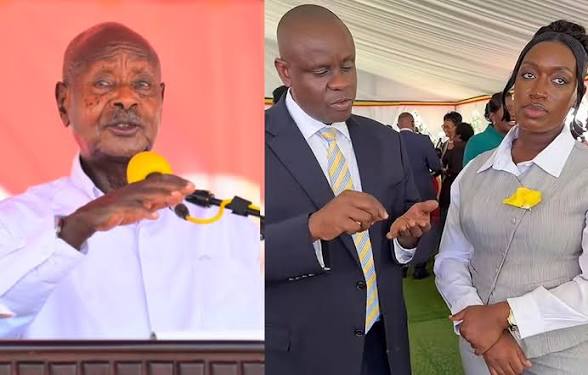
President Yoweri Museveni has spoken out about the political challenges faced by Justine Nameere during the elections in Masaka, claiming that some groups worked against her through misinformation and coordinated efforts.
Museveni made the remarks while addressing members of the National Resistance Movement (NRM) Parliamentary Caucus, where he discussed corruption, political manipulation and the challenges affecting government programmes.
The President praised Nameere and Minister Balaam Barugahara for their efforts in exposing corruption and poor service delivery in different parts of the country.
“I am glad some people are trying to do some little fighting; that is Barugahara and Nameere,” Museveni said.
While commenting on Nameere’s political journey, Museveni claimed that she faced serious opposition during the elections in Masaka.
“This Nameere, they wanted to kill her in Masaka during the elections. There is a way they gang up, misinform people; they are like AIDS. AIDS kills by blocking the body’s soldiers,” Museveni said.

He explained that, in his view, corrupt individuals weaken society by controlling information and influencing public opinion against certain leaders.
“So these corrupt people; they start by taking over the information channels,” the President added.
Museveni said misinformation can be used by groups to turn citizens against leaders who are trying to fight corruption and improve government services.
He argued that some people deliberately spread false information to protect their interests and prevent accountability.
The President linked the challenges faced by Nameere to wider problems within political structures, saying some leaders have struggled because of internal conflicts and manipulation.
Museveni recalled that after the general elections, Nameere and a group of young supporters approached him at Rwakitura to express their concerns.
He said the group informed him that they were disappointed by the challenges they faced and warned that the NRM’s influence in Masaka could suffer because of such problems.
“Some of these had been candidates at various levels. That is how I became interested,” Museveni said.
The President said the complaints pushed him to pay attention to issues affecting the party structures in the area.
He further connected corruption to growing public dissatisfaction with government programmes, saying misuse of resources creates anger among citizens.
Museveni specifically mentioned the Parish Development Model (PDM), saying corruption involving local leaders can damage the reputation of government initiatives.
“So this corruption, where you have local leaders taking PDM money, that is how you get local resentment,” he said.
The President said leaders involved in corruption create unnecessary problems for the government because citizens often blame the entire administration for actions of individual officials.

He praised efforts by Barugahara and Nameere to expose cases of poor service delivery and alleged misuse of public resources.
The two leaders have been travelling across different parts of Uganda, meeting citizens and listening to complaints about government services.
Their campaign has attracted attention because of their public confrontations with officials accused of failing to serve citizens effectively.
Museveni said fighting corruption requires leaders who are willing to identify problems and ensure that government programmes benefit the intended people.
He encouraged more leaders to join efforts aimed at protecting public resources and restoring confidence among Ugandans.
The President’s remarks have renewed debate about corruption, political competition and the challenges faced by leaders involved in exposing wrongdoing within government systems.
About the Author