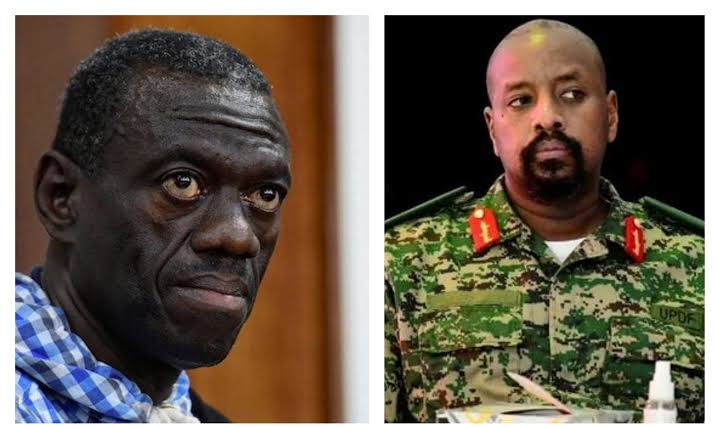
A significant legal battle involving Chief of Defence Forces Gen. Muhoozi Kainerugaba has taken a new turn after the High Court in Kampala ordered him to file a defense within seven days in a human rights enforcement lawsuit brought by opposition veteran Dr. Kizza Besigye and his co-applicant, Hajji Obeid Lutale.
The court directive emerged during proceedings that were expected to advance the treason and misprision of treason case involving Dr. Besigye, Lutale, and Capt. Denis Oola. However, the hearing was unable to proceed as planned after only one of the accused appeared before the court.
When the matter came before Justice Emmanuel Baguma, Capt. Denis Oola was produced in court while Dr. Besigye and Hajji Lutale were absent. Their absence prompted immediate concern from both the court and legal representatives involved in the proceedings.
As a result, Justice Baguma adjourned the case and scheduled the next hearing for June 30. The judge also issued a production warrant directing authorities to ensure that the absent accused persons are presented before court on the next hearing date.
While the postponement of the treason proceedings attracted attention, much of the focus quickly shifted to the separate human rights enforcement application filed by Besigye and Lutale against Gen. Muhoozi and other state officials.
The application names Gen. Muhoozi Kainerugaba, senior military intelligence officers, and the Attorney General as respondents. The applicants argue that several of their constitutional rights were violated through actions allegedly undertaken by security agencies and state actors.

Central to the application are social media statements allegedly made by Gen. Muhoozi on the social media platform X. The applicants claim that some of the posts contained language that threatened their rights and undermined principles of justice and due process.
Among the statements referenced in court documents is an alleged post suggesting that Dr. Besigye would be executed on Heroes’ Day. Lawyers representing the applicants argue that such remarks create fear, prejudice ongoing legal processes, and undermine the presumption of innocence guaranteed under the Constitution.
The legal team further contends that public comments from a senior military officer regarding an individual facing criminal charges have the potential to influence public perception and interfere with the fairness of judicial proceedings.
Beyond the social media allegations, Besigye and Lutale also accuse security agencies of unlawfully abducting them from Nairobi, Kenya, before transferring them back to Uganda without following established legal procedures.
According to their application, the events surrounding their arrest and transfer violated both domestic and international legal protections relating to personal liberty, due process, and cross-border law enforcement cooperation.
The applicants further challenge their earlier prosecution before the General Court Martial, arguing that the proceedings were inconsistent with a Supreme Court decision that restricted the trial of civilians before military courts.
Their lawyers maintain that the actions taken against their clients amounted to serious constitutional violations that require judicial intervention and appropriate remedies from the High Court.
In response to the application, Justice Baguma directed Gen. Muhoozi to formally present his defense within seven days, setting the stage for what could become one of the most closely watched legal battles involving senior government and military officials.

The court order effectively places the CDF under a legal obligation to respond to the allegations raised against him and provide his side of the story before the matter proceeds further.
Following the court session, prominent lawyer Erias Lukwago addressed journalists and emphasized that his legal team would pursue the matter through established legal channels rather than through public confrontations.
Lukwago stated that they would not embark on what he described as a mission to “hunt down” Gen. Muhoozi for service of court papers, expressing confidence that the legal process would proceed in accordance with the law.
Political and legal observers have noted that the case raises important constitutional questions concerning freedom of expression, the conduct of public officials, due process rights, and the relationship between military authority and civilian legal protections.
The proceedings also come at a time when public interest remains high regarding both Dr. Besigye’s legal troubles and Gen. Muhoozi’s increasingly prominent role in national affairs, making every court development a subject of intense scrutiny.
As the seven-day deadline begins to run, attention will now shift to whether Gen. Muhoozi files a defense and how the High Court ultimately addresses the serious allegations raised in the application. The outcome could have far-reaching implications for constitutional rights, accountability, and the interpretation of state power in Uganda.
About the Author