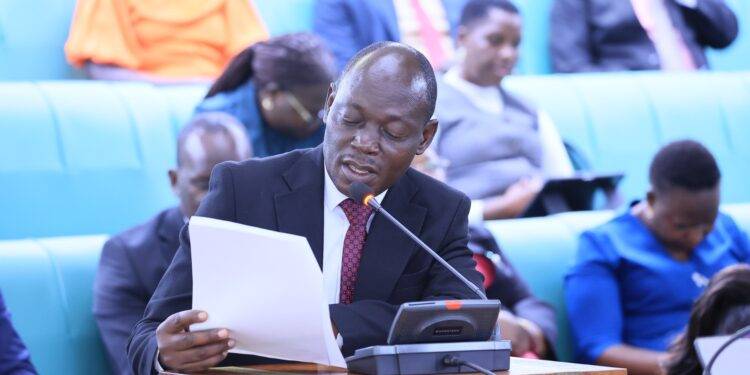
A fresh political debate has emerged after Buyaga West Member of Parliament Dennis Namara formally notified Parliament of his intention to introduce a Private Member’s Bill seeking to amend the Administration of Parliament Act.
The proposed legislation seeks to review the legal framework governing the appointment and removal of the Leader of the Opposition in Parliament, a position currently held by Joel Ssenyonyi.
Namara, who is associated with the Patriotic League of Uganda (PLU), argues that the current arrangement leaves Parliament with limited powers to hold a serving Leader of the Opposition accountable.
According to the legislator, several public offices can be subjected to parliamentary processes that may result in removal from office, including the President, Speaker of Parliament, Deputy Speaker, and Cabinet ministers.
He questioned why the office of the Leader of the Opposition remains largely dependent on the appointing political party when it comes to removal or replacement.
The MP contends that the current system creates what he views as a gap in accountability within Parliament’s leadership structure.

Namara further argued that because the office receives public funding, Parliament should have a greater role in determining accountability mechanisms for whoever occupies the position.
His remarks have sparked widespread debate among political observers, legislators, and members of the public.
Supporters of the proposed amendment argue that all public offices funded by taxpayers should be subjected to clear accountability procedures.
They maintain that Parliament should have the authority to address situations where an office holder is accused of misconduct or actions deemed inconsistent with the law.
Proponents of the proposal also say the amendment would strengthen institutional oversight and ensure equal treatment of parliamentary leaders.
However, critics have strongly opposed the idea, warning that such changes could undermine the independence of opposition leadership within Parliament.
Some opposition supporters believe that allowing Parliament to influence the removal of a Leader of the Opposition could expose the office to political pressure.
They argue that the position was deliberately designed to remain under the control of the largest opposition party to preserve its independence from the ruling establishment.
Political analysts note that the proposal touches on broader constitutional and democratic questions regarding the separation of powers and the role of opposition parties.

Several governance experts have called for extensive consultations before any legislative changes are introduced.
They argue that reforms affecting key parliamentary offices should be carefully considered because of their potential impact on Uganda’s democratic institutions.
Meanwhile, the notification to the Clerk of Parliament marks the beginning of what could become a lengthy legislative process if leave is granted for the bill to be introduced.
The proposal is expected to attract intense scrutiny from both government and opposition legislators as discussions progress.
Observers say the debate is likely to focus on balancing accountability with the need to protect the independence and effectiveness of opposition leadership.
As Parliament prepares to consider the proposed amendment, attention is now shifting to whether lawmakers will support changes that could fundamentally alter how the Leader of the Opposition is appointed, supervised, and potentially removed from office.
About the Author