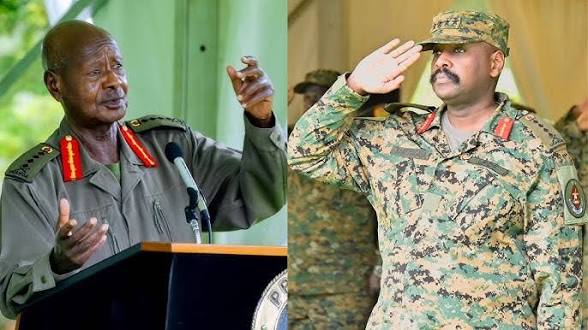
Gen. Muhoozi Kainerugaba has sparked fresh debate on social media after responding to claims questioning whether President Yoweri Museveni is his biological father.
The Chief of Defence Forces made the remarks in a post on X (formerly Twitter), where he reacted to comments from an individual who allegedly claimed that he could not be President Museveni’s son and demanded that a DNA test be conducted to settle the matter.
According to Muhoozi, the individual insisted that he was “definitely a Munyarwanda” and argued that his personality and temperament were inconsistent with those of the President.
The comments appear to have angered the General, who chose to address the matter publicly through his social media platform rather than ignore the claims.
In his post, Muhoozi wrote that he had seen someone claiming he was too angry to be President Museveni’s son and therefore could not possibly be biologically related to him.
He further revealed that the individual had challenged him to undergo a DNA test to prove whether the President was indeed his father.

Rather than dismissing the suggestion, Muhoozi responded directly by declaring that he was fully prepared to take the test if necessary.
“I saw someone the other day saying that I’m definitely a Munyarwanda and can’t be Mzee Museveni’s son. Ngu that I’m too angry to be Mzee’s son. He demanded a DNA test to prove if Mzee is my father. I am ready for the test,” Muhoozi posted.
The statement quickly attracted widespread attention online, generating thousands of reactions, comments, and shares within a short period.
Supporters of the General dismissed the allegations as baseless political attacks and argued that there was no reason to question a relationship that has been publicly acknowledged for decades.
Others viewed the post as another example of Muhoozi’s willingness to directly engage with critics on social media, often responding to controversial topics that many public officials would typically ignore.
The comments also reignited discussions about identity, heritage, and the role of social media in shaping public discourse around political figures.
Some users argued that public personalities are increasingly subjected to personal attacks and speculation that extend beyond politics and into family matters.
Others questioned why such claims continue to surface despite the longstanding public understanding of Muhoozi’s family background.
Political observers noted that the General’s response comes at a time when social media platforms have become key arenas for political debate, speculation, and public engagement.
The DNA reference in Muhoozi’s post also attracted attention because of ongoing national discussions surrounding high-profile paternity disputes and recent DNA controversies that have dominated public conversation.
Many users interpreted his willingness to take a DNA test as an expression of confidence and a direct challenge to those spreading the allegations.
As the post continued to circulate widely, supporters and critics alike weighed in, with some praising his response while others debated the broader issues raised by the remarks.
Although there has been no indication that any actual DNA process will be undertaken, Muhoozi’s statement has once again demonstrated his ability to dominate public discussion with a single social media post.
For now, the comments have added another chapter to the General’s often headline-making online presence, while fueling fresh conversations about identity, family, politics, and the growing influence of social media on national debates.
About the Author